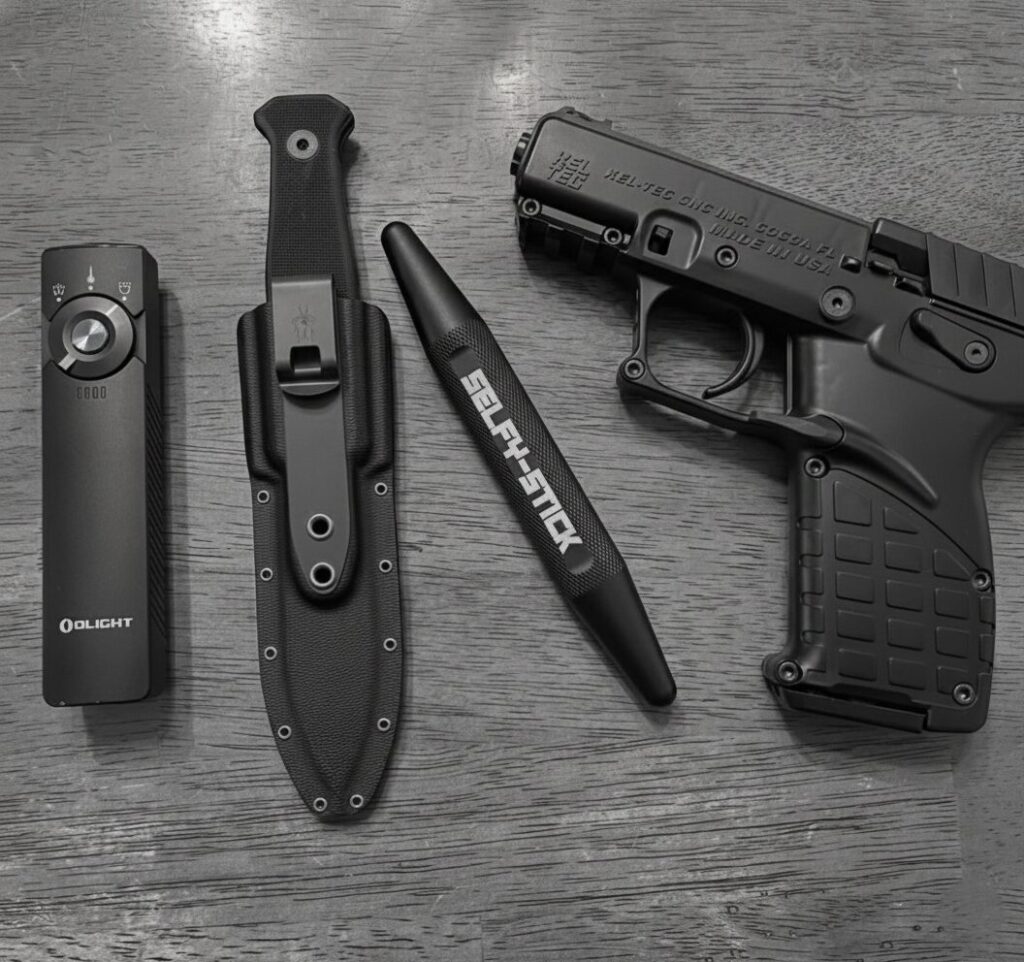
 Real EDC loadout featuring the Selfy Stick — courtesy of @411_outdoors

Most people don’t think about personal safety until the moment it matters most. And by then, thinking isn’t enough.
That’s the whole point of EDC — Everyday Carry. It’s the quiet, deliberate habit of having the right things on you before you ever need them. Not because you’re expecting the worst. But because the people you love are counting on you to come home, and that’s worth a little preparation.
This guide is for people who already understand the value of being prepared and want to build a carry setup that’s actually practical — one that fits your real life, not just the tactical fantasy version of it.
What EDC Self-Defense Actually Means
Everyone already carries an EDC kit — they just might not call it that. Your wallet, your keys, your phone. Those are the basics. For most people, that’s where it ends.
A self-defense EDC setup goes one step further. It’s the intention behind what you carry — choosing tools that make you capable in moments that matter, not just moments that are convenient.
And the three things a good EDC self-defense kit has in common are simple:
- It’s with you — the best tool in the world does nothing sitting on your nightstand
- It’s legal — because a tool that creates legal problems isn’t protecting you
- It works under pressure — when adrenaline hits, simplicity wins every time
That’s it. Everything else is refinement.
The 5 Things Worth Carrying Every Day
1. A Compact Self-Defense Tool
This is the foundation. You want something small enough that you’ll actually carry it every day, tough enough to hold up when you need it, and simple enough to use without thinking. Traditional options like kubotans have been the go-to for decades — but as we wrote in our post on the kubotan vs. the Selfy Stick, the category has evolved considerably.
The Selfy Stick was built specifically for this role. It’s CNC-machined from aircraft-grade 6061-T6 aluminum in Temecula, California — precision-made, not mass-produced. The engineering delivers 125x force multiplication, which means your natural defensive movements hit with real stopping power. No training required. Both tips are engineered for emergency glass breaking, so it earns its place in your carry even on the days you hope you never need it for self-defense. Legal in all 50 states. Available in a 6″ or 8″ configuration depending on how you carry.
If you’re only going to add one thing to your daily carry, this is it.
2. Situational Awareness — Your Real First Line of Defense
Every professional in personal protection will tell you the same thing: the threat you never encountered is the one that didn’t cost you anything. Awareness isn’t paranoia — it’s the habit of paying attention.
Put your phone away when you’re in transition spaces. Parking lots, stairwells, elevator lobbies — these are statistically the highest-risk environments, and they’re also the places people are most likely to have their heads down in a screen. Note your exits when you arrive somewhere new. Trust the instinct that says something feels off. That instinct has been keeping people alive a lot longer than any piece of gear has.
3. A Tactical Flashlight
A bright, compact flashlight is one of the most underrated tools in any EDC kit. At night, light is leverage — it reveals threats before they reach you, temporarily blinds an aggressor, and helps you navigate any emergency with clarity. Modern rechargeable options in the 500+ lumen range now fit on a keychain. There’s no reason not to carry one.
4. Your Phone — Used Intentionally
You’re already carrying it. The question is whether you’ve set it up to actually help you in an emergency. Know your emergency contacts. Use your phone’s built-in SOS features — both Apple and Android have them, and in a real emergency, a single button press can share your location with the right people. It takes five minutes to configure and you only need it to work once.
5. Basic Trauma First Aid
This one doesn’t get talked about enough. A tourniquet and a hemostatic bandage take up almost no space and can genuinely be the difference between life and death in the first minutes after a serious injury — whether that’s a car accident, a workplace incident, or something worse. The Stop the Bleed program has made basic trauma training free and accessible across the country. It’s worth your afternoon.
How to Actually Build Your Kit
Here’s the honest truth about EDC: the perfect setup is the one you’ll actually carry. Don’t let the pursuit of the ideal become the enemy of the good. Start with this:
- Pick a self-defense tool you’ll carry every single day — not just when you remember it. The Selfy Stick 6″ fits in any pocket and you’ll forget it’s there until you need it.
- Add a flashlight. Rechargeable, 500+ lumens, keychain-sized. There are solid options under $30.
- Stash a tourniquet in your bag or your car. The CAT tourniquet is the standard for a reason.
- Set up emergency contacts and SOS on your phone today. It takes five minutes.
- Commit to the awareness habit — phone away in transition spaces, exits noted, gut trusted.
That’s a complete, practical EDC self-defense setup. Add to it as you get more comfortable. Refine it as your life changes. But don’t wait for perfect — start with this.
EDC for Your Life, Not Someone Else’s
The right EDC setup depends on who you are and how you live. Here’s how to think about it for a few specific situations.
If You Commute or Work in the City
Urban environments mean crowds, rideshares, parking structures, and late nights. You need tools that don’t draw attention. The Selfy Stick’s clean, non-tactical profile means it blends into professional life without a second glance — which is exactly the point.
If You Run or Spend Time Outdoors
Lightweight and accessible is everything. A Selfy Stick held in hand or clipped to a running vest gives you both self-defense capability and emergency glass-breaking utility. Pair it with a running safety light and a Road ID and you’ve covered the real risks of solo outdoor activity.
If You’re a College Student
Campus life brings real safety challenges — late nights, unfamiliar areas, limited options. We covered this in detail in our college self-defense guide. The short version: legal, simple tools that work without training are the most practical choice for students who have a lot on their minds already.
If You’re a Parent
Parents’ EDC priorities go beyond themselves. A tool that can break a car window when a child is trapped in a car seat isn’t a luxury — it’s something you hope you never use and can’t afford not to have. The Selfy Stick handles that role alongside its self-defense function, so it’s two critical capabilities in one pocket-sized tool.
A Few Mistakes Worth Avoiding
- Carrying tools you’ve never practiced drawing — even 60 seconds of muscle memory practice matters
- Treating your EDC as a one-size-fits-all solution — layer your preparedness
- Ignoring your local laws — know what you can legally carry where you live and travel
- Letting awareness slip because you’re carrying gear — a tool isn’t a substitute for paying attention
- Buying for aesthetics — your EDC isn’t for your Instagram, it’s for your safety
Questions We Hear a Lot
What’s the best everyday carry self-defense tool for someone just getting started?
Something legal everywhere, small enough to actually carry every day, and simple enough to use under stress without training. The Selfy Stick checks all three. The engineering does the work — you just need to carry it.
Is EDC self-defense legal?
For most tools — compact impact tools, flashlights, standard pocket knives — yes. The Selfy Stick is legal in all 50 states. Other tools like pepper spray, stun guns, and expandable batons have varying restrictions by state and city. Always verify local laws before you add something new to your carry.
Do I need training to carry EDC tools?
Not for tools built around force multiplication rather than technique. That said, familiarity matters — handle your tools regularly so drawing them in a real moment is instinct, not a search. Ten minutes a week is enough to build that comfort.
If You’re a College Student
Same pocket-sized form factor, entirely different engineering standard. The Selfy Stick is aircraft-grade aluminum, precision CNC-machined, with 125x force multiplication and dual glass-breaking tips. A full breakdown is in our kubotan vs. Selfy Stick comparison.
Being Prepared Isn’t About Fear. It’s About Love.
The people who build thoughtful EDC setups aren’t afraid of the world. They love someone — a partner, a child, a parent, a friend — and they’ve decided that love is worth backing up with preparation.
That’s the mindset behind the Selfy Stick. Not paranoia. Not aggression. Just a quiet commitment to showing up capable for the people who need you.
Start simple. Carry something. Build from there. And if you’re ready to add a precision-made, American-built self-defense tool to your everyday carry, the Selfy Stick is waiting for you at selfy-stick.com/self-defense-products.


